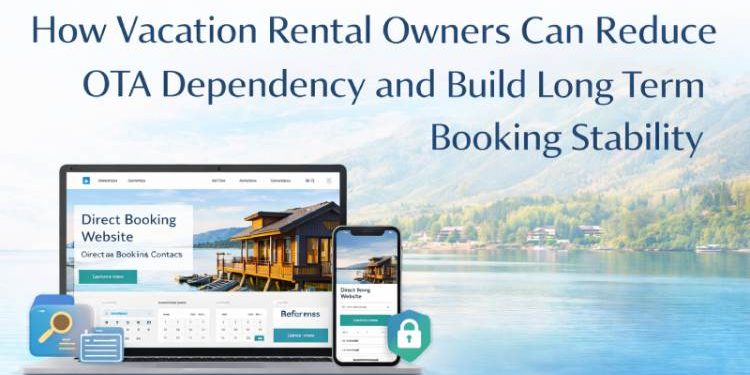
The short term rental industry has matured dramatically over the last decade. What began as a simple way for homeowners to earn extra income through Airbnb has evolved into a highly competitive, data-driven, and professionally managed sector. Today, many operators manage multiple properties, generate significant annual revenue, and rely on short term rental income as a primary business.
Yet despite this evolution, one structural vulnerability remains common across the industry: heavy OTA dependency.
Most vacation rental owners depend heavily on online travel agencies such as Airbnb, VRBO, Booking.com, or Expedia for the majority of their bookings. These platforms offer visibility, payment processing, and built-in trust. They are powerful distribution channels.
However, relying almost entirely on one platform creates concentration risk.
In this comprehensive guide, we will explore what OTA dependency means, why reducing it matters for serious operators, and how vacation rental owners can build a direct booking strategy that improves long-term stability without abandoning major platforms.
This article is designed for owners who want to move beyond hobby hosting and think strategically about asset control, revenue durability, and brand development.
Table of Contents
- What Is OTA Dependency in the Vacation Rental Industry
- Why Heavy OTA Reliance Creates Business Risk
- The Economics of Platform Fees and Margin Compression
- Why Repeat Guests Are the Key to Sustainable Growth
- How a Direct Booking Website Reduces OTA Dependency
- Long Tail SEO for Vacation Rental Direct Bookings
- Direct Booking vs Full PMS Replacement: Understanding the Difference
- When It Makes Sense to Invest in a Direct Booking Website
- How to Gradually Shift Toward a Hybrid Booking Model
- Common Mistakes Vacation Rental Owners Make When Trying to Reduce OTA Dependency
- Building Long Term Brand Equity as a Vacation Rental Operator
- Final Thoughts on Reducing OTA Dependency
What Is OTA Dependency in the Vacation Rental Industry
OTA dependency refers to the degree to which a vacation rental business relies on third-party platforms for bookings, guest communication, payment processing, and visibility. In practical terms, it describes a situation where most revenue flows through platforms like Airbnb or VRBO rather than through channels the operator directly controls.
For many new hosts, this model makes sense. OTAs provide built-in traffic, search ranking systems, review credibility, and secure payment processing. They remove friction from launching a listing.
However, as operators scale to multiple properties, the dynamic changes. When eighty or ninety percent of bookings originate from a single platform, that platform becomes a gatekeeper. Visibility is determined by ranking algorithms. Guest messaging is mediated through platform dashboards. Policies and fee structures are outside the owner’s control.
This is not inherently negative. It simply means the operator’s business is partially outsourced.
The question is not whether OTAs are useful. The question is whether relying exclusively on them is prudent for long-term stability.
Why Heavy OTA Reliance Creates Business Risk
When an operator depends almost entirely on a single OTA, they are exposed to structural risks that are often invisible until a disruption occurs.
First, platform policy changes can alter cancellation terms, payment timelines, or listing requirements. These changes are often implemented globally and affect hosts simultaneously. A policy adjustment intended to protect guests may increase host liability or reduce operational flexibility.
Second, algorithm updates can impact visibility. A small drop in ranking may significantly reduce inquiries. Unlike owning a website with organic search traffic, platform ranking is controlled by proprietary systems that hosts cannot audit or influence directly.
Third, account flags or suspensions can occur due to guest disputes, review conflicts, or misunderstandings. Even temporary suspensions can disrupt cash flow if alternative booking channels are not established.
Fourth, hosts do not fully own guest relationships. Although communication occurs, the platform controls messaging interfaces and guest data. This makes it difficult to build an independent repeat guest ecosystem.
For owners with one property and flexible income needs, these risks may be manageable. For operators managing multiple properties with fixed expenses, staff, or mortgages, dependency becomes more consequential.
Reducing OTA dependency is fundamentally about risk diversification.
The Economics of Platform Fees and Margin Compression
Another important dimension of OTA dependency is economic. Most platforms charge service fees or commissions. These fees are often perceived as a cost of doing business, and in many cases they are justified by exposure and trust.
However, when analyzed at scale, platform fees compound.
Consider a multi-property operator with several listings averaging strong occupancy and nightly rates. Over a year, platform commissions may represent a substantial expense. While these fees support guest acquisition, repeat bookings theoretically require less acquisition cost.
If repeat guests return through the platform by default, the operator continues paying commission on bookings that originated from a previous stay.
Reducing OTA dependency does not necessarily eliminate fees. Instead, it introduces an alternative channel where repeat guests can book directly. Even a modest shift of returning guests to a direct channel can improve margins over time.
The objective is not fee elimination. It is margin optimization.
| Factor | OTA Booking | Direct Booking Website |
|---|---|---|
| Guest Acquisition | Platform-driven | Owner-driven |
| Platform Fees | Ongoing commission | Payment processing only |
| Control Over Guest Data | Limited | Full control |
| Brand Visibility | Platform brand first | Your brand first |
| Algorithm Risk | High | None |
| Long Term Equity | Platform asset | Your asset |
Why Repeat Guests Are the Key to Sustainable Growth
In the vacation rental industry, repeat guests are often the most valuable segment. They already trust the property, understand expectations, and require less marketing persuasion.
Repeat guests tend to generate stronger reviews and fewer disputes. They are also more likely to recommend the property to friends or family.
If every repeat guest returns through an OTA, the operator benefits from occupancy but continues paying platform fees and remains within the platform’s ecosystem. If some repeat guests instead return through a direct booking channel, the operator strengthens their independent revenue stream.
This is where the concept of reducing OTA dependency becomes practical rather than theoretical. It is about capturing incremental stability from guests who already value the property.
How a Direct Booking Website Reduces OTA Dependency
A direct booking website for vacation rental owners functions as an owned digital asset. Unlike an OTA listing, it exists independently of third-party platforms.
A well-built direct booking website allows an operator to present properties with full branding control. It includes property pages, high-resolution photography, policies, local guides, and booking request flows. It may also integrate secure payment processing through providers such as Stripe.
When a previous guest searches the property name in Google, the direct website should appear prominently. Over time, this creates a parallel booking channel that complements OTA exposure.
This hybrid model reduces dependency without sacrificing discovery. OTAs remain valuable for attracting first-time guests. The direct booking website becomes the infrastructure for returning guests and referrals.
Importantly, a direct booking website does not require abandoning platforms. It requires layering ownership alongside distribution.
Long Tail SEO for Vacation Rental Direct Bookings
Search engine visibility plays a central role in reducing OTA dependency. When potential guests search for terms such as “direct booking website for vacation rentals”, “how to get direct bookings without Airbnb”, or “reduce OTA dependency for short term rentals”, they are expressing commercial intent.
By optimizing content around long tail keywords such as “how vacation rental owners can reduce OTA dependency”, operators can attract guests and industry peers seeking alternatives to exclusive platform reliance.
Long tail SEO works because it captures specific search intent. A guest searching for a specific property name combined with “direct booking” is more likely to convert than someone browsing generic travel queries.
For operators serious about long-term stability, SEO becomes part of the infrastructure strategy. It supports discoverability outside of OTA ecosystems.
Direct Booking vs Full PMS Replacement: Understanding the Difference
One common misconception is that reducing OTA dependency requires replacing existing property management systems or channel managers.
In reality, these are distinct decisions.
A direct booking website can function as a complementary channel without replacing existing PMS software. It may display availability calendars, accept booking requests, and process deposits while still synchronizing manually or through integrations.
Replacing a full PMS involves deeper operational changes. Reducing OTA dependency does not necessarily require that step.
Understanding this distinction prevents overcomplication. The objective is diversification, not disruption.
When It Makes Sense to Invest in a Direct Booking Website
Not every vacation rental owner needs a direct booking website immediately.
It becomes particularly relevant when the operator manages multiple properties, receives repeat guests regularly, or relies heavily on STR income. Owners who plan to scale, build a recognizable brand, or reduce exposure to algorithm shifts benefit most from investing in owned digital infrastructure.
For single-unit hobby hosts with minimal repeat business, the urgency may be lower. For operators with growing portfolios, building a direct booking channel often aligns with business maturity.
The decision should be framed as infrastructure development rather than website vanity.
How to Gradually Shift Toward a Hybrid Booking Model
Reducing OTA dependency does not require abrupt change. A gradual approach is often more sustainable.
Operators can maintain OTA listings for exposure while directing repeat guests to their branded website after the initial stay. Post-stay communication may include a professional website link where guests can view availability and inquire directly.
Over time, as direct traffic increases through search and referrals, the proportion of bookings from owned channels may rise organically.
This hybrid model preserves platform benefits while strengthening independence.
Common Mistakes Vacation Rental Owners Make When Trying to Reduce OTA Dependency
Some operators attempt to reduce OTA dependency by abandoning platforms prematurely. This can result in reduced visibility and occupancy gaps.
Others invest in low-quality website builders that fail to convert visitors. A poorly designed site may undermine trust rather than enhance it.
Another common mistake is neglecting SEO. Simply launching a website does not guarantee traffic. Without structured content and keyword optimization, discoverability remains limited.
Reducing OTA dependency requires strategic implementation rather than reactive decisions.
Building Long Term Brand Equity as a Vacation Rental Operator
Over time, operators who invest in branding, guest experience, and owned infrastructure develop brand equity. Guests begin to recognize property names rather than just platform logos.
Brand equity strengthens pricing power, referral networks, and repeat booking behavior. It transforms a listing into a recognizable hospitality business.
In competitive markets, brand differentiation can protect occupancy during downturns or algorithm changes.
Reducing OTA dependency contributes to this brand development. It shifts part of the business from rented visibility to owned presence.
Final Thoughts on Reducing OTA Dependency
Online travel agencies are powerful distribution tools. They provide trust, security, and global reach. For many hosts, they are indispensable.
However, exclusive reliance introduces structural risk.
Reducing OTA dependency does not require abandoning platforms. It requires adding ownership. A direct booking website for vacation rental owners creates a controlled channel for repeat guests, referrals, and brand growth.
For serious operators seeking long-term stability, diversification is not optional. It is strategic.
If you operate multiple properties and want to build a branded direct booking channel with managed hosting and ongoing support, you can explore our Direct Booking Website for Vacation Rental Owners package here:
Direct Website Bookings for Vacation Rental Owners. Discovery belongs to platforms. Stability belongs to ownership.